Eating for Training Without Turning Food Into Math
Training needs fuel, but nutrition does not have to become a daily calculation. Learn how to eat for energy, recovery, and performance without overcomplicating every meal.
Once you start training regularly, food can suddenly feel more complicated.
Should you eat before a workout?
How much?
What about carbohydrates?
Do you need to track calories?
Should every meal be planned around training?
It is easy to turn normal eating into a system of numbers.
For most people, it does not need to go that far.
You mainly need enough food, enough variety, and a routine that supports the training you are actually doing.
Training needs energy
Strength training is work.
Your body needs energy to perform that work, recover from it, and come back ready to train again.
That sounds obvious, but people sometimes focus so much on protein that they forget the rest of the meal matters too.
Carbohydrates can help provide energy for training.
Fats are an important part of a balanced diet.
Protein supports repair and adaptation.
And total food intake matters.
You do not need to think of these as competing priorities.
A good meal can include all of them.
Carbohydrates are not the enemy
Carbohydrates often get treated like something you need to earn or avoid.
But if you train, they can be useful.
Foods like rice, potatoes, oats, bread, fruit, pasta, and legumes can all provide energy your body can use.
That does not mean you need a huge carbohydrate-heavy meal before every workout.
It simply means there is no reason to fear them.
If you regularly feel flat, weak, or unusually low on energy during training, your overall food intake may be worth looking at.
Sometimes the problem is not motivation.
Sometimes you may simply need more fuel.
You do not need a perfect pre-workout meal
There is no single meal everyone needs to eat before training.
Some people feel good training after a full meal.
Others prefer something lighter.
Some train early and do not want much food beforehand.
What works depends on timing, appetite, digestion, and the type of session you are doing.
A simple meal or snack with some carbohydrates and protein can work well for many people.
The useful question is not whether your meal is “perfect.”
It is whether it gives you enough energy without making you uncomfortable.
Post-workout nutrition does not need to be rushed
There is also a lot of pressure around eating immediately after training.
You finish your final set and suddenly feel like a timer has started.
It has not.
Eating after training is useful, and a meal with protein and carbohydrates can support recovery.
But for most recreational lifters, there is no need to panic if you cannot eat the second your workout ends.
Your overall nutrition across the day matters much more than hitting one exact minute.
A normal balanced meal after training is usually enough.
Do not use exercise to earn food
Training should influence your nutrition.
It should not turn food into a reward.
You do not need to earn a meal because you trained hard.
And you do not need to eat less because a workout was shorter than planned.
Your body needs energy on training days.
It also needs energy on rest days.
Recovery does not stop when you leave the gym.
That is why it is usually more helpful to think about food as something that supports your body rather than something you have to justify.
Pay attention to what your body is telling you
As training volume changes, appetite and energy can change too.
Some people get much hungrier.
Others notice very little difference.
It helps to notice your own patterns.
Are you regularly arriving at workouts with very little energy?
Are you unusually hungry later in the day?
Are you struggling to recover between sessions?
Those are useful signals.
You do not need to count every calorie to notice when your current eating habits may not be matching what you are asking your body to do.
Tracking is a tool, not a requirement
Some people like numbers.
Tracking calories or macronutrients can help them understand what they are eating.
Others find that it turns every meal into a calculation.
Neither approach is automatically better.
If tracking gives you useful information, it can be a helpful tool.
If it creates more stress than clarity, you may not need that level of detail.
You can still make good nutrition decisions by paying attention to your meals, protein sources, fruits, vegetables, portions, and how you feel during training.
Most meals can stay normal
You do not need separate “fitness food.”
A useful meal can simply include:
A protein source.
Some carbohydrates.
Vegetables or fruit.
Some fats.
And something you actually enjoy eating.
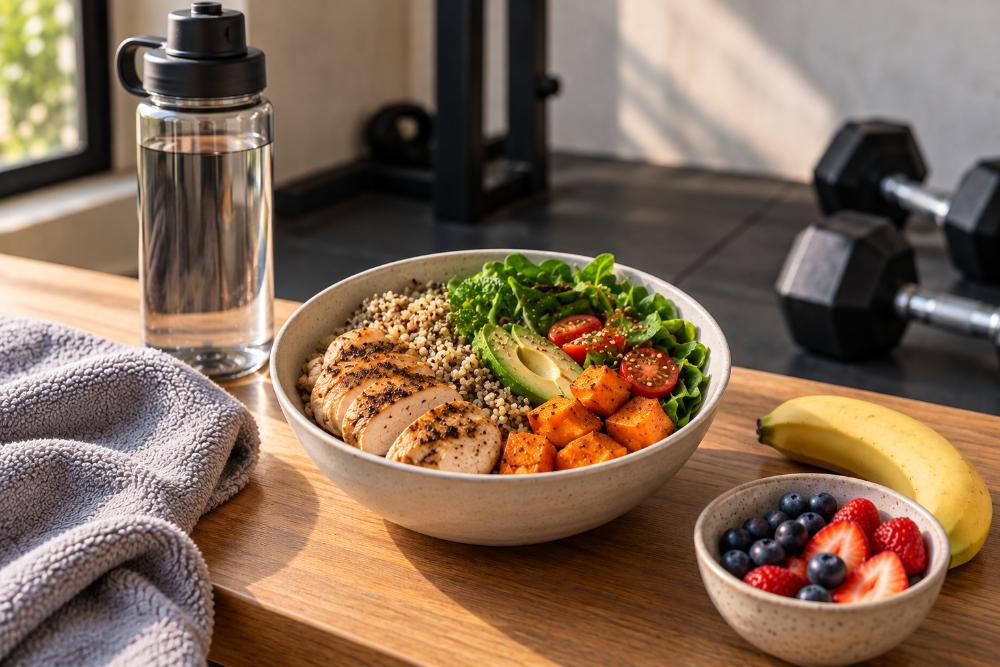
That might be chicken with rice and vegetables.
Eggs with bread and fruit.
Yogurt with oats and berries.
Beans with potatoes and salad.
There are many ways to build a good meal.
The details can change with your preferences, culture, budget, and goals.
Eat to support what you are doing
Nutrition should help you train, recover, and feel good enough to keep doing both.
That does not require every meal to be carefully calculated.
Eat enough to support your activity.
Include foods that give you energy and help you recover.
Notice when your needs change.
Use tracking if it genuinely helps.
And leave enough flexibility for food to remain a normal part of life.
Food should support your training — not turn eating into another workout.